Precision Products. Professional Service.

How to Read a Diamond Blade: Bond, Rim Type and Maximum RPM
Walk past the return counter at almost any rental yard and you will hear the same story: “The blade quit cutting,” “It wore out in a day,” or “It must be defective.”
Often, the blade itself is not the problem—it was simply mismatched to the material or the saw. Before buying or installing a diamond blade, check three important characteristics: the bond, the rim or segment type, and the maximum RPM.
If you are new to diamond blades, Virginia Abrasives’ guide to diamond blade uses and applications provides a helpful introduction to how the blades are constructed and how they cut materials such as concrete, asphalt, brick, block and tile.
The Bond Rule Runs Backward
The bond is the metal matrix that holds the diamonds in place. As the blade cuts, the matrix gradually wears away, exposing fresh diamonds and allowing the blade to remain sharp. The key is choosing a bond that wears at the proper rate for the material—and the rule often feels backward at first.
Soft, abrasive materials such as asphalt, concrete block and green concrete wear the bond quickly. These materials require a hard bond that can resist that abrasion. Put a soft-bond blade on asphalt and the blade may wear out in an afternoon.
Hard, dense materials cause much less bond wear. High-PSI cured concrete containing hard aggregate generally requires a softer bond that releases worn diamonds and exposes new ones. Use a hard-bond blade on that material and the blade can glaze: the diamonds become dull while the bond continues to hold them in place. At that point, the blade begins polishing the concrete instead of cutting it.
A glazed blade is not necessarily worn out. Dressing the blade by making a few cuts in an appropriate soft, abrasive material may remove the glazed surface and expose fresh diamonds. Always follow the blade manufacturer’s instructions before attempting to dress a blade.
Aggregate is also why the same blade can perform differently from one region to another. Limestone, granite, traprock, quartz and other aggregates have different hardness levels. Virginia Abrasives’ aggregate hardness guide shows the types of aggregate commonly encountered throughout different parts of the United States.
Match the Rim to the Cut
The design of the cutting edge affects cutting speed, cooling and the appearance of the finished cut.
- Segmented rims generally cut quickly and run cooler. They are commonly used for concrete and masonry, although they may produce a rougher edge.
- Continuous rims provide a cleaner cut and are commonly used for tile, stone veneer and other materials where the finished edge will remain visible. Depending on the blade, they may be intended for wet cutting or approved for wet and dry use.
- Turbo rims provide a balance between cutting speed and finish quality, making them a versatile choice for materials such as brick, pavers and concrete.
Choose the rim based on the material and the finish the project requires—not simply on what is already mounted on the saw. For example, an aggressive segmented blade that works well on concrete may chip the edge of finished tile.
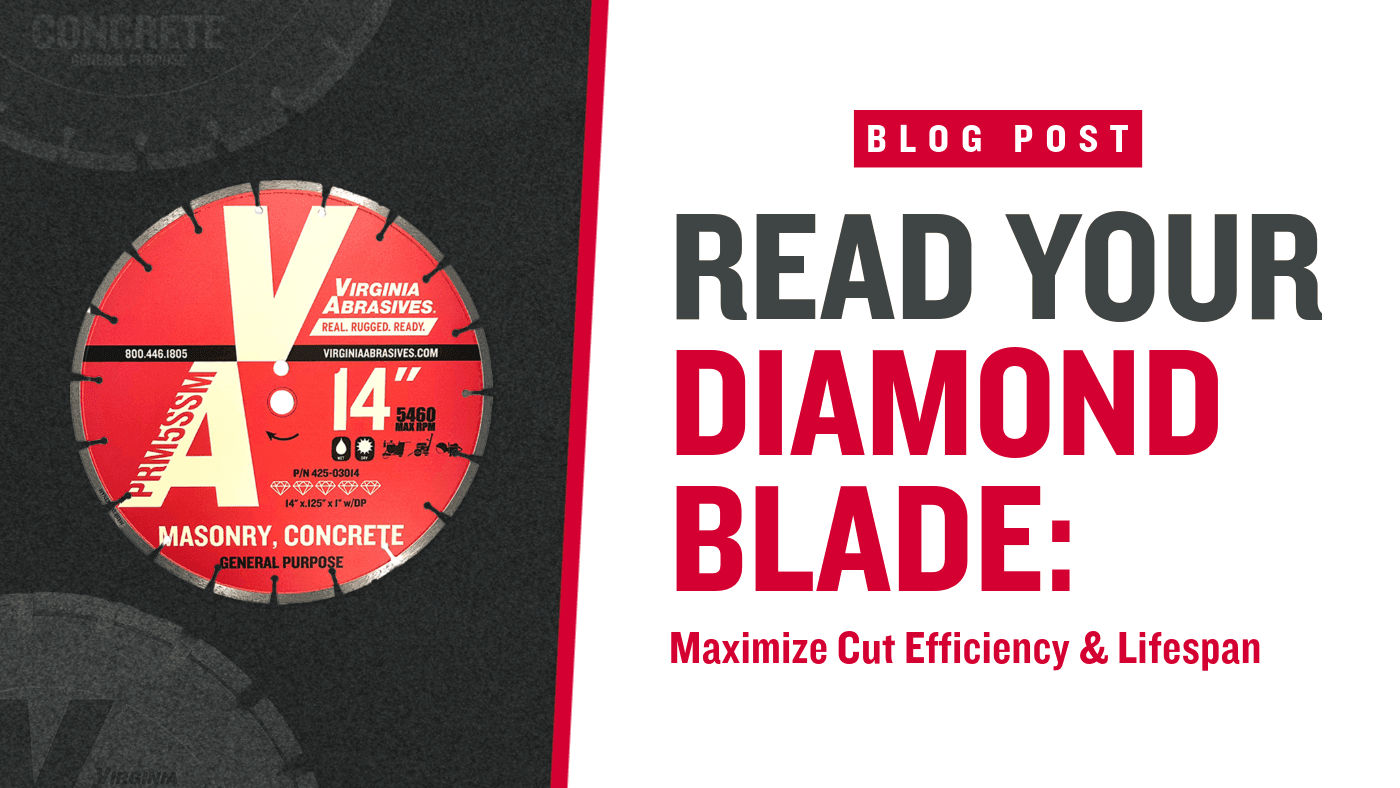
Virginia Abrasives prints important application and category information directly on its blades. The company’s guide to understanding diamond blade categories and labels explains its product-quality designations, segment-type abbreviations and bond ratings.
The RPM Number Is a Ceiling
Every diamond blade has a maximum RPM printed on it. That number is a safety limit, not a recommended target.
Centrifugal force increases with the square of rotational speed. A blade operated 20 percent above its rated speed experiences approximately 44 percent more centrifugal force than it would at the rated speed. A blade failure at high speed can cause serious injury.
The rule is one-directional: the blade’s maximum RPM rating must equal or exceed the saw’s operating spindle speed. For example, a 14-inch blade rated for a maximum of 5,500 RPM can be used on a compatible saw operating at 5,350 RPM. A blade rated below the saw’s spindle speed must never be used.
Do not rely solely on an online retail listing for the saw’s speed. Specifications may be copied from a similar model or listed incorrectly. Check the manufacturer’s manual and the saw’s nameplate, then compare that speed with the maximum RPM marked on the blade. This is especially important when using a rented saw, since you may not know what blade was previously installed.
Also confirm that the blade diameter and arbor match the saw, that the directional arrow follows the saw’s rotation, and that the blade is approved for the intended wet or dry application. Never install a damaged blade, remove the saw’s guard or exceed the blade manufacturer’s operating instructions.
Choose the Right Blade Before You Cut
Before starting your next concrete, masonry, paver or tile project, remember these three checks:
- Match the bond to the material and aggregate hardness.
- Match the rim or segment type to the desired cutting speed and finish.
- Confirm that the blade’s maximum RPM equals or exceeds the saw’s spindle speed.
Get those three things right and the blade is far more likely to perform as intended. Many supposed “bad blade” experiences begin with a mismatch that could have been caught by reading the blade before making the first cut.
*Matt Lipman runs Concrete Cutting Pro, which publishes a printable spindle RPM and arbor chart for common 14-inch cut-off saws using specifications drawn from manufacturers’ manuals. He also serves on the board of Virginia Abrasives.